
Introduction
Healthcare founders can use AI to analyse data faster, guide new research and develop better products. The challenge is deciding which results will matter in clinical practice
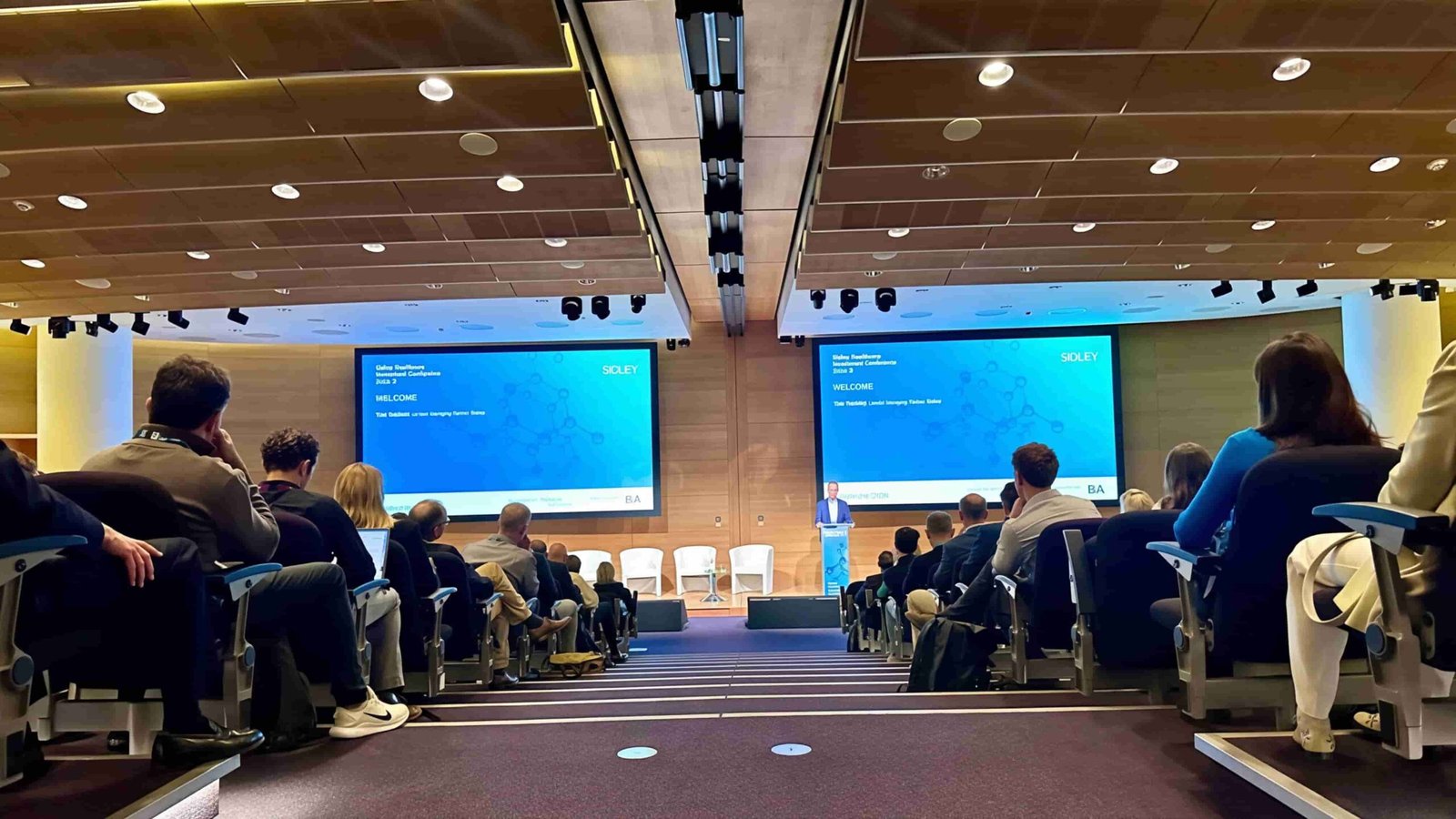
On 22 September 2026, Dr Maria Zalazar, Founder and CEO of MZ Medical, attended the Sidley Healthcare Investment Conference at the Francis Crick Institute in London.
This article focuses on the conference’s AI panel: how AI can guide the generation of new data, what it can contribute to drug development, and why a promising diagnostic test must also work for clinicians and reimbursement systems. It also examines what founders should consider when choosing investors for their company’s future.
What this article covers
- How should biotech founders choose investors for their long-term plans?
- How can healthcare founders build a lasting advantage with AI?
- Can AI-developed diagnostic tests work in clinical practice and secure reimbursement?
- How could AI change which biotech companies investors choose to fund?
- If AI can identify drug targets faster, what does it take to turn one into a medicine?
- What do investors look for when evaluating potential drug targets?
How should biotech founders choose investors for their long-term plans?
Match your investors to the future you are building
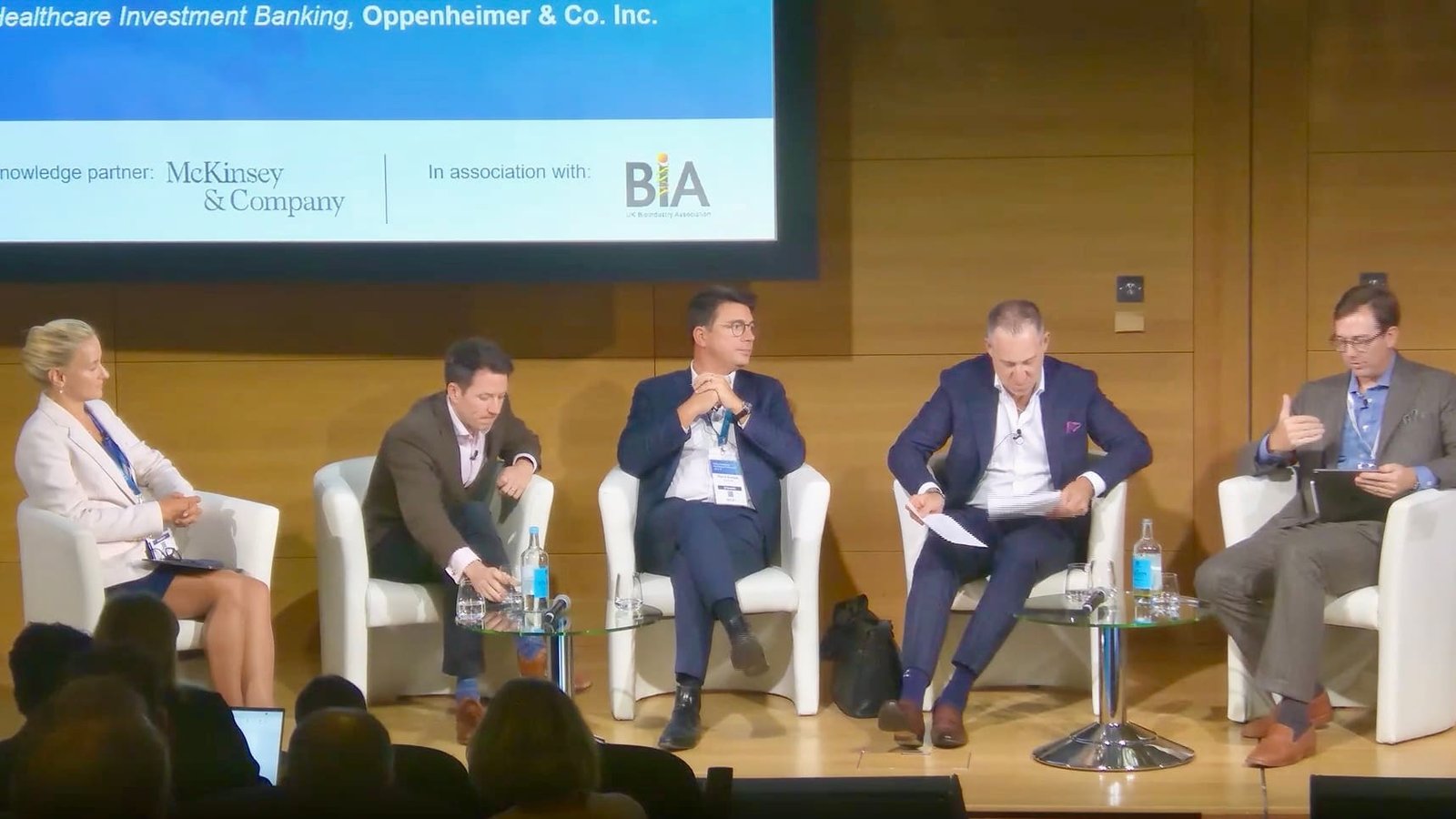
In the final panel, Go West? European Biotech Innovations: U.S. Exits, Dr Nara Daubeney, CEO and Co-Founder of Phaim, urged founders to consider their next steps when choosing an institutional investor. Does that investor have experience with acquisitions and company-building deals, or with taking companies to the public markets?
Her advice went further than choosing a source of funding. Founders should know what evidence their asset needs, which clinical outcomes would make it valuable to a future buyer or public-market investor, and where to spend the capital they raise to reach that point. The investor they bring in should understand and support that path.
How can healthcare founders build a lasting advantage with AI?
Use AI to generate data that makes the next discovery possible
During The AI Imperative: Reshaping Drug Development and Investment panel, Simon Brunner, Principal at Flagship Pioneering, described how AI is changing the speed of research and helping biotech companies decide what data to generate next. He began:
“We all have AI agents at our disposal. Whenever we want to analyse data, we can do it much faster than we could in the past. That extends to writing code.
“In the latest company I’m building, we received our first genomics dataset when we had no code written. By that evening, we had an analysis. Frankly, that would not have been possible a few years ago.
“But the bigger point is that, for the first time, we have systems that can help us decode the language of nature. Take a protein’s sequence and how it folds. The instructions for folding are encoded in the sequence, but humans could never fully make sense of them. Given enough data, AI can. Generate Biomedicines is an example in this space, with AI-designed assets in clinical development.
“I think we will see much more of this: companies generating the relevant datasets needed to solve difficult problems. That is the kind of company we are excited about at Flagship. In a compounding loop, AI directs which data to generate next. That data improves the model, which then helps direct the next round of data generation. Over time, the company builds a valuable model and a distinctive data asset.
“Another example is Expedition Medicines, which works in covalent chemistry on a difficult problem for which we do not yet have enough data.”
Can an AI-developed test work in clinical practice?
Making AI-developed tests usable and reimbursable
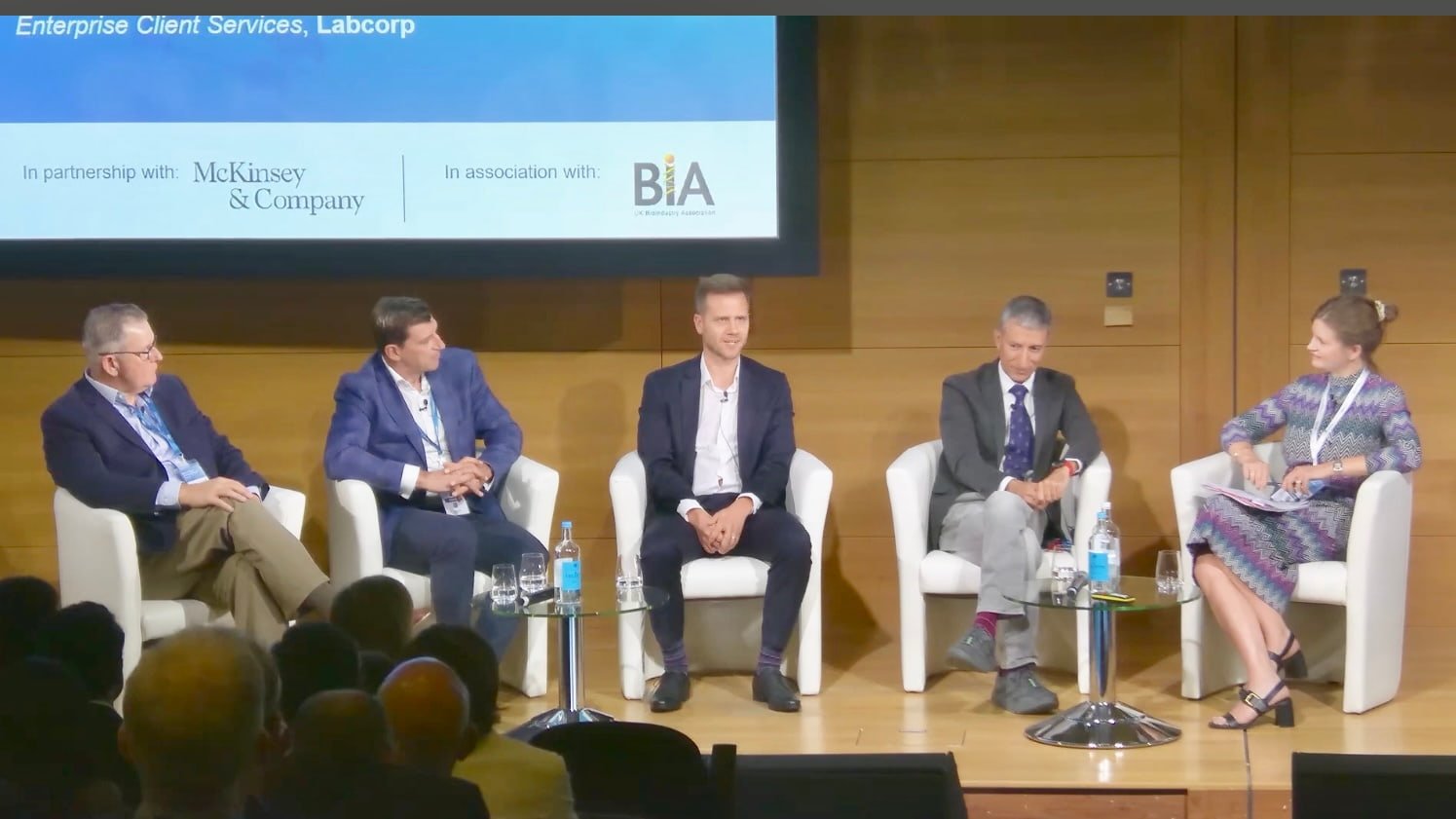
Responding to the panel’s question about where AI has delivered results, Warren Cresswell, CEO of Perspectum, drew on his experience developing tests that analyse many proteins. He began
‘My experience is a little bit different. I think where it’s really been probably very successful for the businesses I’ve been part of is probably the real data analysis side of things.
“So when we’re developing these complex, multi-analyte algorithm-based tests, you know, we look at a number of different proteins, and you can do mass spec on samples and look at thousands of different proteins at the same time. And when you go to analyse those and develop a product, you know, that algorithm may come back and say, ‘Hey, these hundred proteins or two hundred proteins are actually additive to an algorithm to be able to give a better result, potentially.’ And maybe you’re looking at the ability to determine if a patient is responding to therapy, as an example.
“But then if you put the lens over that and take a look at, from a reimbursement perspective, could you actually commercialise a product like that? The answer is no, and I’m speaking directly of the U.S., because the way reimbursement really operates in the U.S., the best way to do it is you take a look at the national fee schedule, and then you look to see, ‘Hey, what other products are on the market and how much reimbursement have they gotten?’
“And then you also take a look at all the individual contributions of those proteins, and what you find is typically it’s a very small handful that makes up most of that algorithm. So then what you do is you really kind of back into the product design, because there’s also no way you could ever commercialise something like this in the marketplace, because physicians would have to understand if you gave them a report and said, ‘There’s two hundred proteins on this,’ and then the first thing a patient’s going to do is they’re going to ask and say, ‘What does this mean?’
“So it’s very interesting that you have this tool that will really give the best technology, the best-performing assay, but you actually make these active decisions to back it off to make it a commercial assay.”
How could AI change which biotech companies investors choose to fund?
AI makes some drug development tasks easier and investors may place greater value on companies tackling harder problems or discovering valuable new targets
Later in the panel, Simon Brunner returned to how AI might change investment decisions. He said:
I would say it is exciting to think about the potential shifts in the questions that are going to be investable, right? If you think about best-in-class molecules, especially on the antibody side, we’re seeing a lot of progress from AI, and probably there the bar is going to get higher to make investment decisions in the future, given that the technology is becoming more commoditised and available.
“But if we’re talking about first-in-class, then at least for known targets, those are going to be really hard targets. And so I think, to Hutan’s point, we’re sort of out of distribution. We don’t have the data necessarily available to train models that can crack those.
“But then just sort of a thought experiment around thinking ahead, 10, 15 years down the line, how some of these developments might shift how we think about valuations. Target discovery, I think, is an interesting example. I have a bit of experience in that area with Quotient Therapeutics, a company I co-founded that is in that space, and generally the wisdom is always target discovery is a hard business because you have to invest until you actually get a target, and then you have to invest a lot more to get from the target to the drug.
“Now, arguably some of the targets that target discovery companies find aren’t so hard to drug, right? And so if we think 10 years down the line that perhaps AI can come up with that molecule fairly quickly and really compress timelines, that might actually level the playing field for target discovery companies versus pure-play drug discovery companies.
“So I think it’s interesting to think about these shifts and, you know, identify, I guess, investment opportunities that will become more relevant as AI sort of takes over more and more of the drug discovery pipeline.”
For more on what investors ask founders during a pitch, read here
If AI can identify drug targets faster, what does it take to turn one into a medicine?
AI may identify drug targets much faster, but turning a promising target into a real medicine still requires biological validation and clinical testing.
Andrew Fleming of Labcorp referred to the Stanford research covered in “Virtual biotech company puts thousands of AI scientist agents to work on drug discovery”. He then explained what AI could speed up and what still requires biological and clinical work:
‘ I think, who talked about forming a virtual biotech company where he had 37,000 agents reporting into an agentic chief scientific officer. Set them, you know, all divided into their different subgroups within, as you would see in a traditional biotech company, analysed 50,000 clinical trials over the course of a week and came up with a potential target, an ADC target, that six months later a major pharma company identified as being, you know, a key target for them too.
“So the identification can certainly be sped up. The limitation, quite in that paper as well, is still: how do we get from this? How do we kind of—I don’t want to use the word monetise—but how do we get this from a theory, an identified target, to a real drug? And that’s where, you know, this biology piece kind of takes over and that clinical decision still has to be made. But that’s where the speed is, and that’s where the speed is very, very possible to improve on a process level.”
What do investors look for when evaluating potential drug targets?
Why does genetic evidence matter to investors?
Josefine Sommer, Partner at Sidley, asked what investors look for when assessing new drug targets. Simon Brunner addressed the question:
“ I think the bar needs to be high for target discovery endeavours because, by definition, we are operating in a space where, to your point earlier, I don’t think we’re very good just yet at understanding clinically things a priori before going into the clinic. It’s clear that genetics-based data or genetics-based targets are so far the only way that we have to improve probability of success in the clinic by about two and a half fold versus, like I said, are not genetically supported.
“So I think we put a high premium as an organisation on target discovery with some level of genetic support, but I think we’re excited about new ways of looking at genetics and also excited about opportunities to convince ourselves that going beyond genetics into other fields is relevant, especially, for instance, when we uncover entirely new types of targets from the genome, such as a company called Profound Biomedicine is doing, where they’re looking at targets coming from the dark genome.
“But yes, I think it needs to be a high bar whenever we do go ahead with a target discovery company, just because of the very specific uncertainty involved in building these companies.”
Conclusion
AI can help healthcare founders analyse data, identify drug targets and accelerate research. The discussions at Sidley also showed what must happen next: findings need biological and clinical validation, and diagnostic tests must be useful to clinicians and viable for reimbursement.
For investors, the strength of the evidence matters. Simon Brunner described why genetic support can make a drug target more compelling, while also recognising the uncertainty of target discovery. Dr Nara Daubeney raised a decision founders face earlier: choosing investors whose experience fits the company’s intended path, whether that leads towards an acquisition or the public markets.
About the author

Dr Maria Zalazar is the Founder and CEO of MZ Medical, an international women’s health advisory company developing its own innovative projects. She has nearly 20 years of experience in women’s health and genetics, with an international career spanning Argentina, Spain and the UK.
What was discussed at the Sidley Healthcare Investment Conference 2026 in London?
Panels covered healthcare investment, biotech exits and the use of AI in drug development. This article focuses on the points most relevant to healthcare founders
How is AI being used to discover new drug targets?
AI can analyse biological and clinical data at scale to identify targets worth investigating. Researchers must then test whether those targets are relevant to disease.
Can AI-discovered drug targets become medicines without laboratory or clinical testing?
No. Identifying a target is an early step. Scientists must develop and test a treatment before its safety and effectiveness can be established in patients.
Why do investors look for genetic evidence when assessing a biotech drug target?
Genetic evidence can strengthen the case that a target plays a role in disease. It may reduce uncertainty, but it does not guarantee that a treatment will work.
How could AI change investment decisions for biotech companies?
If AI makes some discovery tasks faster and more widely available, investors may place greater value on companies with distinctive data, difficult targets or a clear route towards a treatment.
Why is a high-performing AI diagnostic test not automatically a viable product?
A test also needs results that clinicians can understand and use. Founders must consider its cost and the reimbursement available in the market where they intend to sell it.
How can a healthcare company build an advantage from its AI data?
It can use each analysis to guide what data to collect next, then use the new data to improve its models. The value depends on the quality and relevance of that data.
What should a biotech founder consider when choosing an institutional investor?
Consider whether the investor’s experience fits the company’s likely path, including future funding rounds, an acquisition or a public listing
What did the Stanford virtual biotech study show about AI agents in drug discovery?
Its AI agents analysed thousands of clinical trials and proposed research directions rapidly. The findings still require testing and validation in the real world
Industry Insights
Insights for Healthier Ageing
.
Women’s Resources & Services